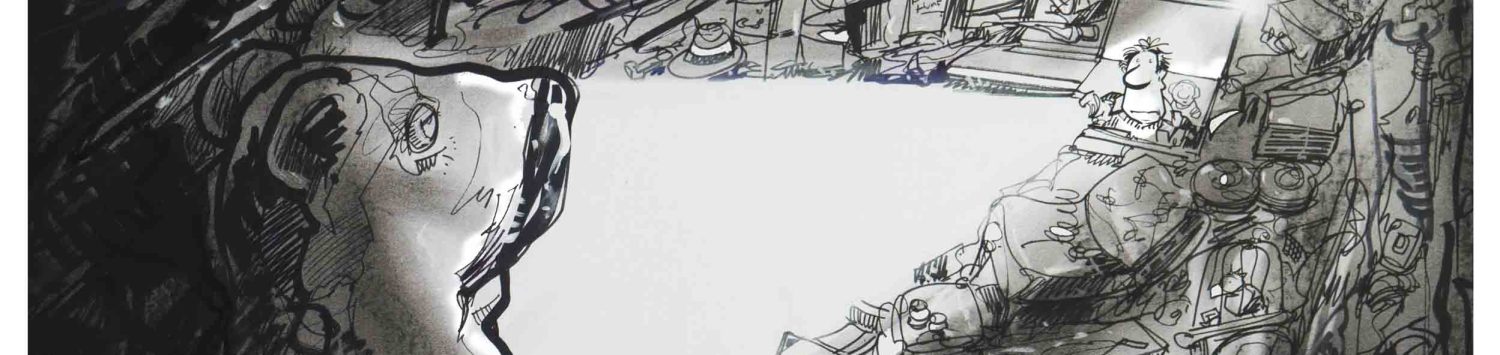

I’d been a freelance cartoonist for just over 30 years and had sort of passed my ‘sell by’ date. At the time I was 58 years old and my typical day was to get the kids in the car to drive them to school or meet a friend half way, and take his, or he’d take mine. A good arrangement. David was the sales director of Severnprint, a company who I had used to print various things for me and my clients over the years. The company wwas based in Gloucester and had a good well deserved reputation.
One morning on the changeover of small people he asked me if I knew anyone who might be interested in a job as a salesman ( the official title was customer service manager, but we all knew it meant salesman ) I said, only half joking, ‘Yes I do, me!’. He looked at me and asked me if I was joking, and I said, ‘No, I think I could do that’.
You’ll have to have an interview and wear a tie, he replied. I said I promised I would and said I was happy to be interviewed. The post involved running a brand they’d called ‘Sprinters’ which was intended to attract business from small businesses and to compete with Kall Kwik, a sort of instant print high street operation that was doing well. Severnprint was seen as a large print company uninterested in the smaller jobs, but it was interested in any job it could get,small or large.
I went home after delivering the kids, to my studio in the house, with its dwindling work load and to grappling with my new apple Mac computer, making very little money, and discussed the idea with my wife. ‘why not’ was her response.
I got the job, wore the tie, went to work at a ‘proper job’ for the first time with regular money every month and paid holidays. They gave me a desk and a computer and a bloke called George to work with, in an open plan office with other, much more experienced sales and production people around me. It took some time to get used to the idea that everyone around me could hear me when I was on the phone, trying to drum up trade.
In general I liked the work, and I really liked the people I worked with. The factory, a large rambling building on an industrial estate just on the edge of the city had the sales office on a floor over the big machine room, where these huge full colour printing machines churned out sheet after sheet of printed goods. They were capable of printing thousands of sheets an hour. I loved the sound of them, and the buzz of it. In the centre of the factory the design studio and pre print people spent their days in a windowless room looking at the work that was to be printed and checking it all to make sure it would. Platemaking and pre production people got another windowless room. The man on the guillotine spent his day cutting paper, the regular thud of the massive blade chopping through the finished print, one false move could have ruined it, but I know of no times when this happened. A large area next to that was staffed by the finishing department, where they creased folded packed and got the job ready for delivery.
They even had an office staffed by ladies in white gloves who knew all about hand folding paper and doing stuff that machines could not do.
Digital print was brought in and operators trained to use them, so that short run colour print became an option for small businesses as well as the large volume work done by the big litho machines.
The accounts department next to us in sales kept the place financially viable and chased the money, with the MD, in his little glass office next to them.
The van drivers at the end of the chain, there were three of them when I joined, would take the finished products to wherever the client was, and that could be almost anywhere in the South West and beyond.
The business was run by the Pealing Brothers, sons of Ken Pealing who founded it, and died sadly quite young. Simon was the MD, Nigel the Production Director, and David ( never call him Dave, I’ve seen him wince when it happened) was my boss: the Sales Director.
I was there for ten years, until I retired when I was 68. I never regretted it. I liked the people who worked there, and with some notable exceptions I liked my customers. It was never dull.
Not long after I retired the Pealings sold the business to the employees. A sort of spirited “John Lewis” type of business idea. They sold it again to some business people, as I understand it. Now they are closing down the Gloucester factory. It’s not common news and I only found out through someone who used to work for them. In many ways the company changed character after the sale of the Pealing brothers. Businesses take on a character, I’ve always thought. When I worked for ad agencies, lots of them, in the 70s and 80s one could characterise them as types. One agency where the creatives only turned up for work at 11.00 and went home at 9.00 might be described as a hippy. Another where the creatives wore suits and ties might be more likely described as a dour old gentleman. Hippies were good to work for, but might take a while to pay. Old Gents were ok but generally came up with conservative ideas, a bit dull, but paid on the nail.
Severnprint was a bit like a country farmer, took a keen interest in environmental matters, enjoyed a healthy life and was slightly rosy cheeked from a surfeit of local cider. Oroight?
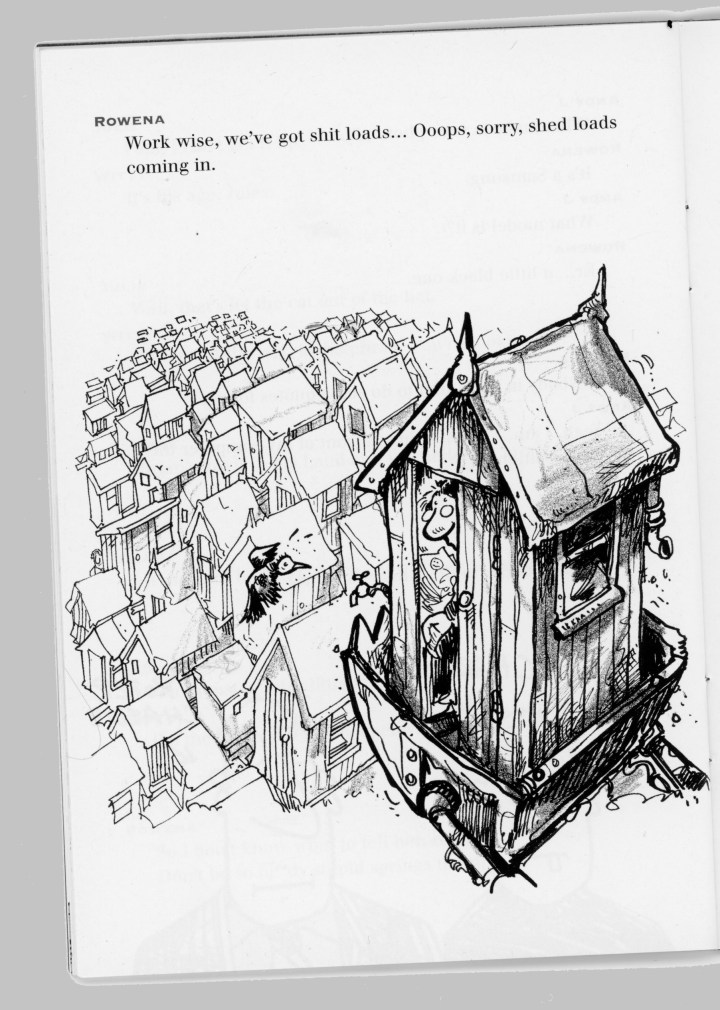
From ‘Witty’s Little Red Book’ a small publication that we produced for a few years when I was at Severnprint which was a collection of overheard comments noted or collected by my colleague Mike Witt. We gave them away at Christmas and they generally went down very well, giving the impression that we lived in a fun factory which was not the case, it was a busy productive but generally fulfilling place to work with some first class people, most who had a fine sense of humour to boot.
 Paul Davies Cartoons & stuff
A sad day indeed Paul. I spent the last 10 years of my working life there before retirement. Great memories of a great and skillful workforce and a few ‘oddballs!’ An enjoyable place to work and a company with a creditable respect for the environment and a solid focussed environmental approach to materials used and processes aimed at protecting our planet. Clive
Agreed Clive.
The brothers’ Dad and founder was Ken (Kenneth) Pealing, not Frank.
I’m so sorry, don’t know what I was thinking. I will amend the information.
Amended.
That was a great read Paul. 🙂
I can’t believe I was there for 22 years!x
I hope you’re well.
Thanks Kate. I am well. I was there for 10 and it seems a long time ago now. Very sad to see it go. xx