

There are several sorts of workers. Some love the job, and some can’t stand it but have to do it. I’ve always been lucky that I’ve loved my work. Not every hour of every day, but for most days it was a pleasure to work. In fact, some people thought, when I was drawing cartoons for a living, that it wasn’t really work at all. I’m not sure whether they were right. When I changed career and became a salesman, I was surrounded by people (which was a change from the lonely desk experience that drawing had become).
Here are my brief impressions of my time at Severnprint.
Yeah, there were loads of people every day. People I was trying to sell to and others who I worked with. I think it’s fair to say that not many of the people I worked with enjoyed their work in the same way that I did. I should also say in all my time working at the printers, there were few people that I did not like; most of my fellow workers were hard-working and sometimes, by necessity, good-humoured.
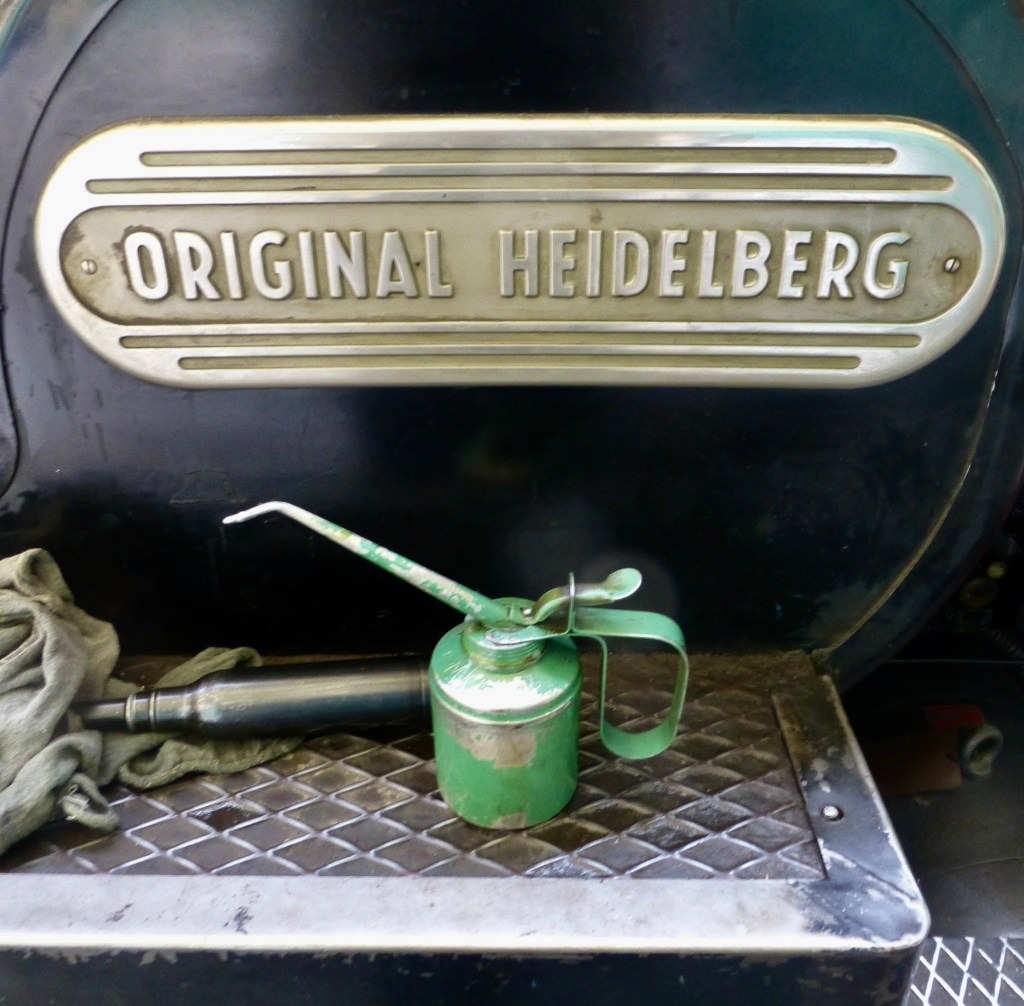
Another thing that I liked at the printers was the sound of those machines, especially the big ones. In fact, a Heidelberg printer running at full speed, which is roughly 10,000 sheets of paper per hour, is really something to behold. And in my time there I think they had four of these beasts. So when all four were running it could be noisy, a sort of ‘thrum’ ran through the factory.
Imagine going to work each day standing at a guillotine, pushing around paper and chucking the waste into a massive waste ‘basket ‘.As well as the printing machines, one could hear the thump of the blade all day when John was busy, which seemed to most of the time. He was the go-to man for cutting operating his huge guillotine at the back of the factory. He cut almost all the print coming off those huge Heidelbergs.
Round the corner: another huge area, again full of machines. Finishing machines.
Have you ever wondered how that tiny sheet of paper in a prescription box advising you that you might get a hot flush, a rash and even more severe side effects from what you are taking? Those could be folded here! Along with machines to bind, fold, and crimp into almost any form.
In the corner, another Heidelberg, this one converted from a printing machine into a cutter. In a rack behind it, a whole set of shelves full of cutting forms. Basically sheets of solid plywood with shaped blades stuck to the board, to give the shape of whatever piece of print was to be cut. The operator here, a jolly cheerful chap with a strong Gloucester accent, had a selection of elastic bands and string attached to some of the levers of his Heidelberg, enabling the machine to operate to maximum efficiency. He knew that machine and its foibles, though he was unlikely to know what a foible was. It is thought that he’d been a master baker in the City when he was younger, his skills now persuading an old printing machine to cut out a folder or other sort of shaped print item.
The potential for print to go ‘wrong’ is huge and one large print job can take several people to get it from the factory to the customer. The finishing department, as this area was called, is probably the one which carried maximum risk.
If it something did go wrong and was reasonably rejected, then the procedure was simply: to print it again and get it right. The aim every month was to get our ‘Spoilage ’ figures as low as possible.
Another part of the finishing department, when I joined, was the large office/ studio area at the front of the factory, where there was a small population of women wearing white gloves for their work. Doing ‘handwork’: hand folding some tricky pieces or sticking glue dots to others. These were the very fiddly jobs that you can’t ask a machine to do. Putting string through a label hole? That sort of thing. Some of this was at times put out to what were called ‘outworkers’, local people who could do some of these pieces of hand work at home in front of East Enders.
The despatch department hovered around this end of the factory. Delivery drivers were loading their vans with boxes of finished print, and paper was coming in on huge trucks. This was being unloaded onto a forklift truck, generally by a small, lively forklift woman who frightened the lorry drivers with her banter about being ‘an apprentice on day release ‘. She was actually an expert on that forking lifter.
In the heart of the factory stood the macroom. Here the work was checked and, in some cases, designed for the print. The ‘Big Cheese’ here when I joined looked like a refugee from a heavy metal band. He was in fact in a band, I’m not sure how heavy the metal was. Next door were the plate-making machines for the big presses, operated by a laid-back sort of chap who must have had excellent eyesight; you’d need that to check all those hundreds of printing plates.
Later on in my time there, digital print came in, and large digital print machines were installed in a new reconfigured area.
Back through to the front of the factory, and here was the production office.
Around four production staff were here, who determined when and where everything would be printed. Along a long wall was a production board, with every machine marked and several slots. It was like a huge paper spreadsheet calendar on a long wall. Every job in the factory appeared on that board, the colour on the card indicating who the salesperson was. I was the magenta! The MD was marked as black, to match his prevalent mood ( his colour generally dominated, as he generally looked after the big gun clients, which might have given him a that rather ‘hunted’ demeanour )
A production meeting at ten each morning got all the reps estimators and production staff together to ‘discuss’ what had priority. To say these meetings could be tense is a bit of an understatement. Coming away from it with a job that had been put back meant a difficult call to a customer.
Upstairs on the next level above the production office in the rafters of the factory was the Sales and Accounts office. A large open-plan office ( think of the TV series ‘ The Office ’, and you have the right picture). ‘ Anyone seen my stapler?’ This is where my own desk was located, though for much of the day, especially in the early days, I got out and about looking for work, or going to see existing customers.
Our MD worked from a small glass-walled office at the back of this large room, with the accounts staff nearby. The rest of us worked all together, and phone calls were overheard, and any dispute could be painfully public.
In the ten years that I had there, people came and went; we lost one colleague to crime, which was painfully sad; others moved on to other jobs. There was generally a good-natured atmosphere and a fair amount of good humour. Mr Jordan had a fine line in put-downs. In general, there was a mix of men and women, and our own office manager was a fine woman with a matching fine Gloucester twang to her speech. She promised to hunt me down if I ever wrote about my time there.
Is that ok, Rowena? That wasn’t too painful, was it?
I recall that about 45 people were working for the company when I joined. After 30 years as a freelance cartoonist, it amazes me that they took a chance on me. The company was run by the three brothers Pealing: Simon, the MD. Nigel, the Production Director, and my own boss, the Sales Director, David.
Sadly, when they retired, it changed hands and is no more today. The Factory was sold and is now part of an engineering company.
That concentration of talent in Gloucester has now dissipated; no more Heidelbergs tended by a man with elastic bands. For me, it was ‘back to the drawing board’some years before the company closed its doors. I imagined it would go on forever, but sadly not.
I was there ten years, and it was good for me, and good to me.
I came into possession of this fuzzy bit of video of the Severnprint Sales Office, taken by colleague Susan Morton. It gives a fair impression of what it was like. My desk was behind Matt, the bloke answering the phone. I must have been out trying to sell, or on paid holiday ( a concept new to me at the time )

